Cloud Atlas: My Thoughts
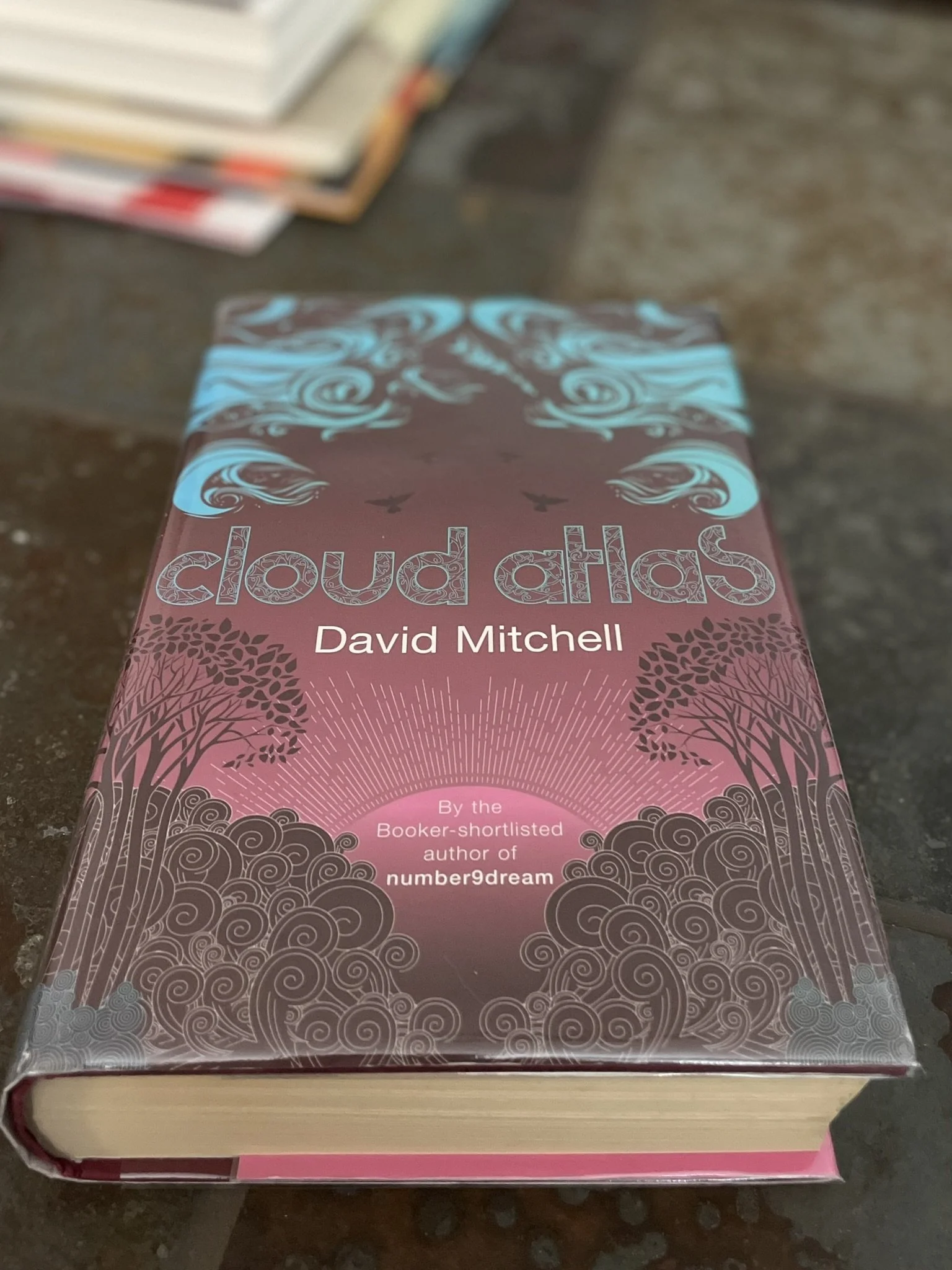
“Cloud Atlas” has been on my TBR list for almost two decades. On October 11, Simon D. (a friend in Singapore) resurfaced this novel, recommending that I should read it if I haven’t already. I have a copy at my home in Malaysia, but I also wanted a first edition (2004), so I found a copy from https://biblio.co.uk/ and paid £0.96 for it. When the book arrived 2 weeks later, I gave it a good wipe, wrapped it, and catalogued it in LibraryThing. I started reading on 1 November, finished on 8 November. I. Loved. It.
In Cloud Atlas, author David Mitchell masterfully employs a nested, matryoshka-doll structure, weaving six distinct narratives set across eras—from the 19th century to a post-apocalyptic future. Each story comes in two halves, and after the central, uninterrupted sixth narrative, the earlier ones unfold in reverse order (1-2-3-4-5-6-5-4-3-2-1). This palindromic arrangement underlines the themes of cyclicality and interconnectedness.
The characters—Adam Ewing (#1, 1849), Robert Frobisher (#2, 1931), Luisa Rey (#3, 1975), Timothy Cavendish (#4, 2012), Sonmi~451 (#5, likely in the 22nd/23rd century), and Zachry (#6, long after civilization’s collapse)—are richly connected, crossing time and narrative boundaries. Their stories, from victims to agents of change, reflect the persistent recurrence of oppression, the quest for truth, and moments of redemption.
What I loved most: Mitchell’s linguistic feat. He doesn’t just write six stories—he conjures six distinct registers, each convincingly tied to its era. He even invents future dialects: Sonmi~451’s interview uses texting abbreviations and brand-names-as-verbs, while Zachry’s post-apocalyptic tale fractures English into a phonetic patois that initially frustrates, then mesmerises. The prose adapts to each epoch—a testament to extraordinary range and rigor. Recurring motifs (a comet-shaped birthmark, a haunting sextet) tie the tapestry together.
Set in Pacific islands, corporate towers, dystopian states, and wild futures, the novel shows how ship logs evolve into boardroom agendas, yet cruelty and kindness still drive society. Instead of sinking into cynicism, it points to grace and resistance and asks the real question: can we change the tune, or are we doomed to replay old refrains? Do we build each other up—or tear each other down?
Cloud Atlas is an audacious puzzle-box of a novel: six voices, centuries, continents, genres. The structure dazzles—like an Escher print folding into itself—but the deeper achievement is Mitchell’s ability to unite disparate lives under existential questions of decency, power, and human choice. In his ambitious atlas, clouds reveal not only the traces of who we were—but the outlines of who we might yet become.
For readers who follow its rhythms and trust Mitchell through all six parts, the novel gives back as much as it asks. It leaves a lasting mark on the mind, not with comet-shaped birthmarks but with the sense that stories—and souls—come around again.
Please skip this part if you have not read “Cloud Atlas,” as I feel it may ‘annoy’ you and spoil the enjoyment for you. I don’t think of the following as a spoiler, but I do want to note my observations of Mitchell’s meticulous craftsmanship. Each narrative exists as an artifact within its successor: Adam Ewing’s journal appears as a torn book in Robert Frobisher’s letters; Frobisher’s correspondence surfaces in Luisa Rey’s possession; Rey’s story becomes a manuscript submission; Timothy Cavendish’s ordeal transforms into a film; Sonmi~451’s testimony becomes scripture. This ontological nesting grounds the novel’s sprawl, giving readers compass points that act like a guide or anchor amid the jumps through different time periods in the story.
“A half-read book is a half-finished love affair.”