Lecture 6 of 14: Listening to Jiddu Krishnamurti
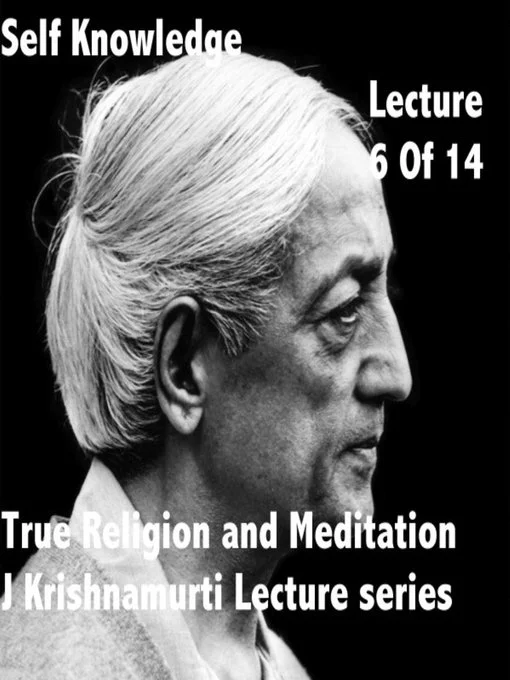
Here’s another one that I finished listening to today: Lecture 6: True Religion and Meditation. Here is my reflection (I’m trying a slightly different format again).
On True Religion
Religion as sensation
Krishnamurti says most of us live by sensation, i.e., moving from one thrill to another. Rituals, prayers, ceremonies, and organized dogma become another kind of sensation: they soothe, stimulate, or make us feel good. But repetition inevitably leads to boredom. That cycle—seeking sensation, tiring of it, seeking another—cannot touch reality.Religion as direct experiencing
For Krishnamurti, true religion is not in churches, temples, or inherited formulas. It is the direct capacity to meet life as it is, without escape. Escapes (whether through ritual, belief, or tradition) are forms of sensation and distraction. When one ceases to seek sensation, the emptiness we fear is revealed. And in facing that emptiness, something genuinely new can unfold.Self-knowledge as the root
He ties religion to freedom and self-knowledge: to be free, one must understand oneself, not through borrowed values but by examining how the mind actually functions. This self-knowledge is the beginning of wisdom, the living ground of religion.
On Meditation
Not discipline, not concentration, not prayer
Krishnamurti rejects conventional forms of meditation:
Discipline: If you “practice” kindness or focus on becoming something, it’s still ego-centered, strengthening the self.
Concentration: Fixing the mind on an image, word, or point is exclusion and suppression—not true quietness.
Prayer: Repetition may calm the mind, but the “answers” that arise are shaped by desire and gratification; therefore, self-deception.
Devotion: Pouring love to a God you don’t know is still projection.Examination of distraction
Instead of pushing distractions away, Krishnamurti says: examine each one. By understanding distraction itself, the mind naturally grows incapable of being distracted—it’s no longer suppression, but comprehension.Meditation as self-knowledge
Real meditation begins with clarity in thought and seeing what is, without justification or condemnation. Meditation and self-knowledge are inseparable: without one, the other cannot exist. A quiet mind emerges not through compulsion but through awareness of desire, escape, and the whole movement of thought. This leads to transformation, a freshness no authority or ritual can grant.
—
From today until the end of September, I plan to listen to a series of lectures given by Jiddu Krishnamurti in 1949 to an audience in Ojai, California. These lectures—14 of them—are digitally remastered recordings available in an audiobook collection from NLB.
Related posts: