Lecture 7 of 14: Listening to Jiddu Krishnamurti
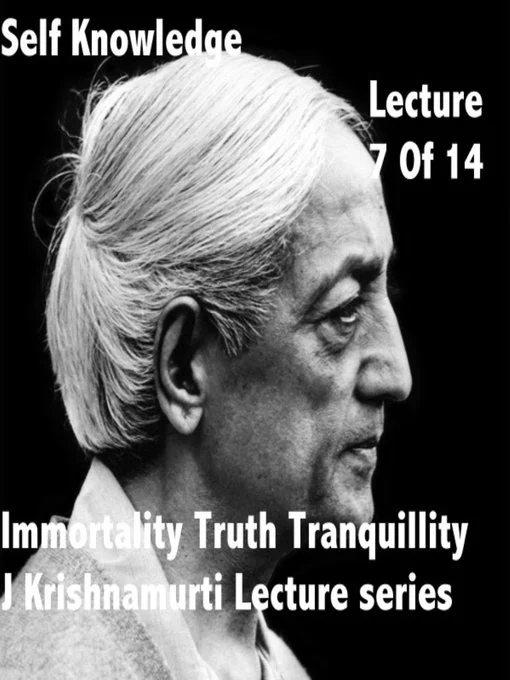
Here’s another one that I finished listening to today: Lecture 7: Immortality, Truth, Tranquility.
My Reflection:
On Immortality. Immortality lies beyond thinking. True immortality cannot be grasped by thought or idea. It exists in a state of pure experiencing, where the usual separation between the “experiencer” and the “experience” dissolves.
On Truth. Thought must cease for direct truth. When ideation—thinking, verbalization, conceptualizing—stops completely, an authentic encounter with truth (and immortality) becomes possible.
Here, I want to go a step further by mentioning what Krishnamurti said about fact versus truth. A fact is simple: anger, fear, joy, lust—all just what they are. They are not “true” or “false.” They just exist. Illusion comes in when we filter facts through prejudice, justification, or interpretation. “Anger is wrong, anger is justified, anger means I’m strong/weak”—these are ideas, not truth. Truth shows itself only when the mind is alert, watching without justification or condemnation.
Truth isn’t sentimental, romantic, or theoretical. It’s not in visions or images, no matter how beautiful. Those are projections of the mind. A mind cluttered with ideas cannot see clearly. When the mind drops these (a mind that is free of ideas), what remains is a direct seeing—an awareness that is not colored by desire, possession, or identity. That is where truth lives.
On Tranquility. Tranquility arises without effort. We don’t want to be inwardly dead, though—it is not that. Tranquility emerges through heartfelt, wordless experiencing. It is not as a result of effort or suppression (either through justification, condemnation, or just by giving it a name), but as a natural unfolding when thought has ended. In other words, tranquility is blocked by fear and seeking (the pursuit of things).
I want to delve a bit deeper into tranquility from the perspective of seeking answers to a problem. Krishnamurti explains that tranquility is not the reward for solving the problem, but it is the condition in which the problem can actually be understood.
Krishnamurti says: when we face a problem, we usually bring fear (What will happen to me?) or seeking (How can I fix this quickly?). Both are distractions. They take our attention away from the problem itself and funnel it into escape routes. Fear wants avoidance and seeking wants satisfaction—neither leads to clarity.
He invites us to look at problems differently: a problem is not asking for analysis first, or for quick answers. It is asking to be seen fully, without the filter of fear or the rush toward solutions. If we are afraid, we don’t actually look. If we are seeking, we only look for what pleases us. But if we are simply attentive, without demand, the problem reveals its nature. So, a problem asks only for attention.
So, to really bring this home, Krishnamurti’s key move is this: tranquility is not something we achieve by examining, dissecting, or managing our problems. Those things may happen, but they don’t produce tranquility. Tranquility arises naturally the moment we are not afraid of the problem. When fear drops away, attention is whole, and in that total seeing, the mind becomes quiet. This is what it means by tranquility arises without effort.
—
From today until the end of September, I plan to listen to a series of lectures given by Jiddu Krishnamurti in 1949 to an audience in Ojai, California. These lectures—14 of them—are digitally remastered recordings available in an audiobook collection from NLB.
Related posts: